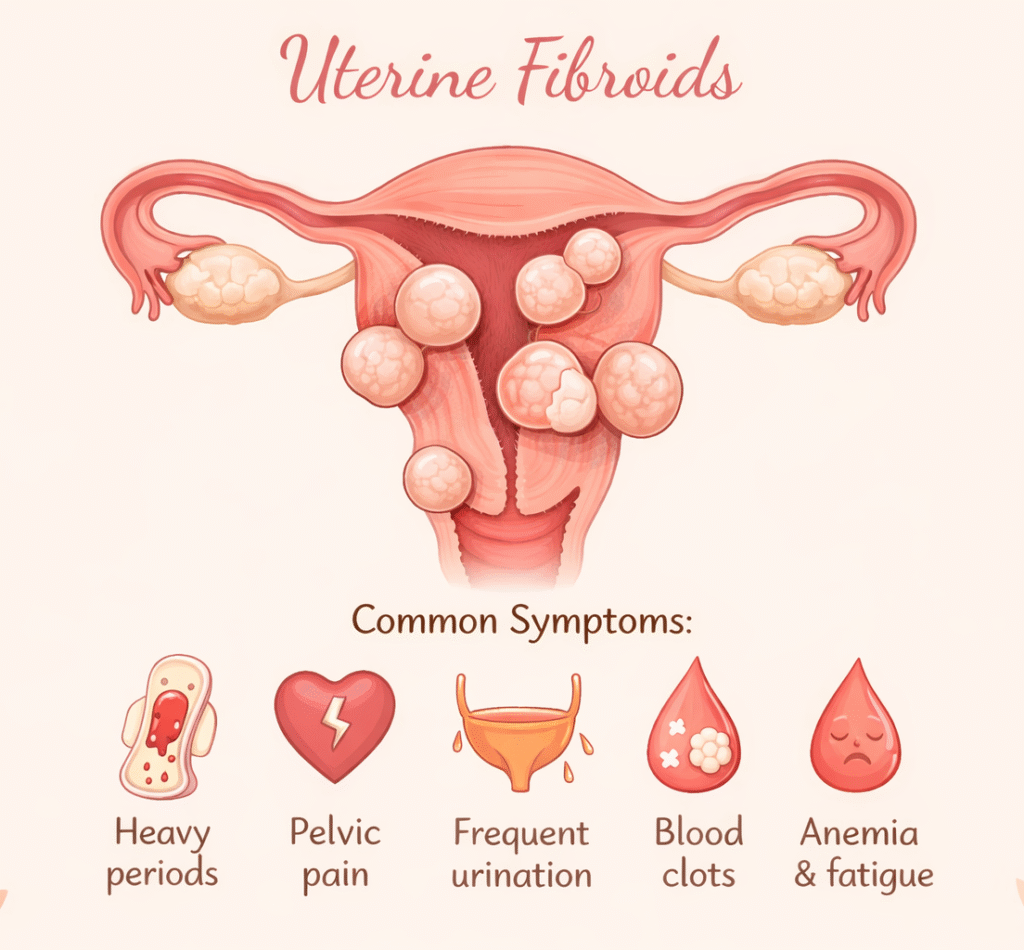
When a woman hears the words, “You have uterine fibroids,” many thoughts rush into her mind.
Questions start coming one after another.
Why did I get this?
What will happen now?
Will it grow bigger?
Do I need surgery?
At the same time, fear and confusion quietly settle in.
This reaction is very natural.
When we do not understand something, we feel more afraid.
Many women try to search the internet for answers. However, instead of clarity, they often find scary stories that increase anxiety.
So, let us pause for a moment.
Let us understand what uterine fibroids really are, why they develop, and how healing is possible—in a calm and simple way.
What Are Uterine Fibroids?
Uterine fibroids are non-cancerous growths that form in the muscle of the uterus.
The uterus is the organ where a baby grows.
Fibroids can be:
- Very small or quite large
- Single or multiple
Many women have fibroids and do not feel anything at all.
Others may notice changes in their body over time.
Fibroids do not appear suddenly.
They usually grow slowly, over many years.Common Symptoms of Uterine Fibroids
Every woman is different. Some women have no symptoms. Others may notice:
Heavy Periods
Fibroids can make the uterine lining thicker. Because of this, bleeding may become heavy or last longer.
Blood Clots
When bleeding is heavy, the body forms clots to slow it down.
Lower Abdominal Pain or Heaviness
Larger fibroids may press on nearby organs, causing a dull ache or heaviness.
Frequent Urination
If fibroids press on the bladder, the urge to pass urine increases.
How Are Uterine Fibroids Diagnosed?
Fibroids are commonly diagnosed using:
- Ultrasound
- Pelvic examination
- MRI (in selected cases)
These tests help understand the size, number, and location of fibroids.
Treatment for Uterine Fibroids
Modern medicine offers options such as:
- Pain relief medicines
- Hormonal treatment
- Fibroid removal surgery
- Uterus removal in severe cases
However, not every fibroid needs surgery.
Treatment depends on symptoms, age, fibroid size, and personal choice.
Does the Location of the Uterine Fibroid Matter?
Yes, it does.
The location often explains the symptoms.
Fibroids Inside the Uterus
- Affect periods
- May impact fertility
Fibroids in the Uterine Wall
- Cause pain or heaviness
- Create pressure
Fibroids Outside the Uterus
- Press on bladder or bowel
- Cause discomfort
So, the scan report gives us important clues.
Why Do Uterine Fibroids Develop?
Doctors know that:
- Hormones play a role
- Family history matters
But many women still ask,
“Why did this happen to me?”
Very often, fibroids are linked to long-term stress.
Think of it like this:
If you carry a heavy bag every day, your shoulder starts to ache.
In the same way, when the body carries stress for years, it shows signs inside.
How Stress Affects the Uterus
The uterus is deeply connected to:
- Feeling safe
- Nurturing others
- Femininity
- Relationships
- Emotional security
When a woman:
- Feels unsupported
- Suppresses emotions
- Carries responsibilities alone
- Worries constantly
…the body tries to adapt.
Sometimes, this adaptation shows up as extra tissue growth, which we later call a fibroid.
Uterine Fibroid Location and Emotional Patterns
Submucosal Fibroids
- Grow inside the uterus
- Cause heavy bleeding
- Often linked to inner fear or feeling unsafe
Intramural Fibroids
- Grow within the uterine wall
- Cause pain or pressure
- Seen in women who silently endure stress
Subserosal Fibroids
- Grow outward
- Press on nearby organs
- Often linked to feeling overburdened
A Gentle and Natural Way Toward Healing Uterine Fibroids
Healing starts with understanding the root cause.
The first step is to release emotional holding.
This happens through:
- Awareness
- Acceptance
- Alignment
Practices like meditation, mindfulness, and emotional awareness help release stored stress and restore balance.
Another supportive approach is homoeopathy, an energy-based science.
It works by gently increasing inner balance and supporting the body’s natural healing response.
Healing is not forced.
It happens when the body feels safe again.
A Message for You
Your body is not your enemy.
It has been protecting you the best way it knows.
Healing is in your hands.
And it is always your choice.
Frequently Asked Questions (FAQ)
Are uterine fibroids cancerous?
No. Most fibroids are non-cancerous.
Do uterine fibroids always grow?
No. Some stay the same size for years.
Do all uerine fibroids need surgery?
No. Many women manage fibroids without surgery.
Can uterine fibroids shrink naturally?
In some cases, yes—especially when balance improves.
Does stress affect uterine fibroids?
Long-term stress can influence hormones and tissue growth.